Tubes of tube type air coolers are prone to leak after many years of operation. There are numerous reasons of tube leak, like: poor quality of material, poor water quality in cooling water system, low tube thickness, vibration, and erosion of material due to water flow velocity etc.
During service, if tubes start leaking, it has to be attended immediately to limit the loss of water and protect engine. Identifying leaky tube is a cumbersome job, usually instructions about identifying leaky tube is never found on board or suggested by maker, word-of-mouth procedure is being carried over by engineers, many have not experienced it by own, however there are several successful practices followed on board. During our discussion with some of senior engineers, we have found many practices.
It is of crucial to identify the leaky tube in shortest possible time to avoid delays and longer stoppages. Many times, wrong procedure lands crew in repeat of work, causing frustration and discouragement, so we will discuss the procedure, how to identify leaky air cooler tubes in service, without repeat of work.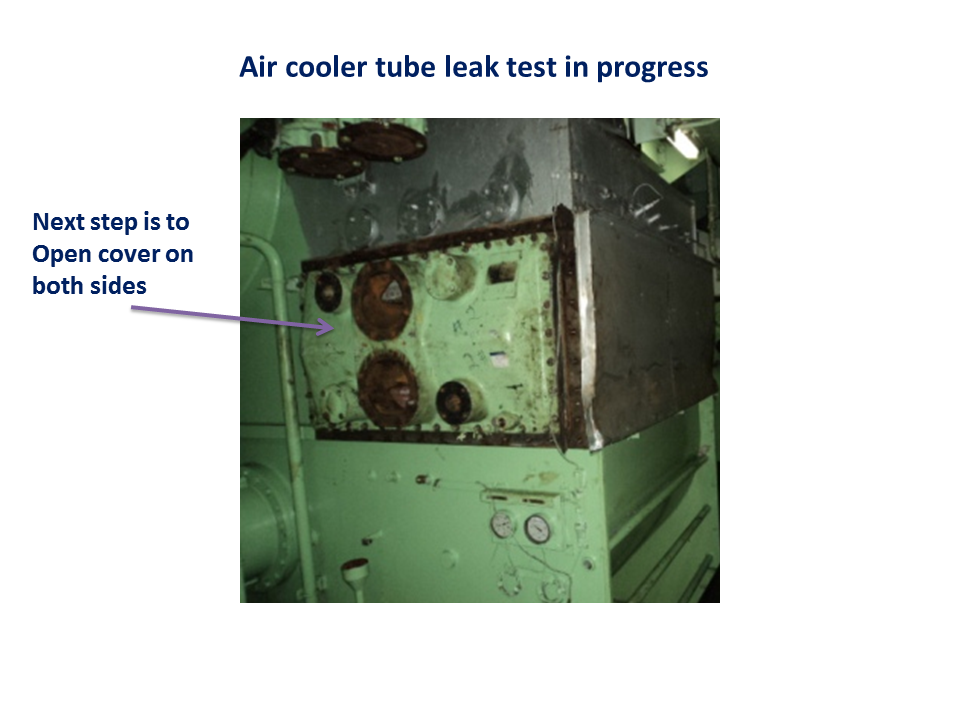
My colleague sent me a brilliant experience, which he used on board his vessel few months back. 45000bhp main engine had three air coolers, one of them was leaking badly, and fresh water loss was around 500liters per day. The leak was small few weeks back; crew did not get opportunity to open the cooler due to lack of time, no permission from port authority and short port stay. The job was delayed and water leak increased from few litres a day to 500ltrs a day.
Methods to identify leaky tubes are during service are as below;
- Open water and check the water leak from air side, however due to arrangement of tubes and fins, this never gives correct identification of leaky tube.
- Second method is to open both side covers of the cooler, use water jet from one side of the tube and plug another side of tube openings, for few hundred of tubes, this method would take whole day to complete this inspection, so we should avoid this method.
- Third method is used mostly due to ease and faster result, materials required for this method are;Candle light , or Soap solution, or hand blow lamp
Cardboard, or plywood, or thin metal sheet
One of the Chief engineers has described his wonderful experience about identifying the leaky tube; first of all, both side end covers were opened up, all 3 auxiliary blowers were started, after end of the tube plate was covered with cardboard, so there was only one passage for air escape. The air from scavenge space passes through outside of the tubes to inside/ water side through hole or crack of the tube. In case the tube hole is big, slight air blow can be felt at the open end of waterside of the tube.
How to identify this slight air blow from leaky tube? Soap solution, small gas torch or a lit candle can be used to identify the leaky tube. Air leak through tube or tubes will break the soap bubble or create flicker in candle light or gas torch.
If the tube leak is small, it is difficult to identify the leak, in one case it could not be identified with auxiliary blower air pressure, which is usually only 0.1 bar. Crew were under pressure to find the leaky tube but their whole exercise was in ineffective, fortunately vessel was in anchorage, chief engineer decided to run the engine with air cooler end covers opened, master permission was sought to run the engine at dead slow for few minutes, at this speed air pressure was sufficient to deflect the candle light and leaky tube was identified successfully. After identifying the leaky tube the plugging of tube is not a time consuming job.
Sometimes some unorthodox method is applied in solving the problem, it is one of them.

 Marine Vault
Thanks for the shared experiences, it was very useful to detect the leaks that we had in an air cooler of the main machine. We managed to identify and solve the problem. Greetings from the tanker Miguel Hidalgo ll. Pemex from Mexico. regards
LikeLike
Dear sir,
People’s nature is to shortcut or look for easy and convenient short time solution, our most of the problem germinate from this short time easy solution. The case of wrong valve operation is really a case which continues for years, and same valve operation is handed over to reliever proudly. The new engineer or operator, most of the time, never bothers to find the right valve to operate.
Appreciate your experience and right feedbacks, I certainly would like to add it in my update.
LikeLike
Dear Shri Amarnath Ji,you have mentioned many causes,but negligence is also a main reason.In order to maintain temperature,shutting off of wrong valves leaves upper tubes starved of water with resultant overheating,and consequent leaks.that is why,regular and proper rounds is essential,especially during maneouvreing,irrespective of whether it is long or short.pls also ensure thermometers are working and alarms tested in sequence.here is where,correct training to juniors becomes essential.in another case,improper chemical cleaning,without proper flushing,caused deposits on inside of tube,reduced water flow,and consequent overheating and failure.usually,the wrong chief is left holding the baby.office Superintendents too must pay close attention to abstract figures,faults are always shown up as early warning somewhere.maybe I am being harsh on myself,but in 90 percent of the problems I faced,I always felt,I could have avoided it by noticing early signs,either. By me or my staff.But ultimately the responsibility is mine alone as Chief.
Regarding identifying leaky tubes,some trigger happy people,plug a whole lot of unnecessary tubes,thereby leading to further problems.
LikeLiked by 1 person